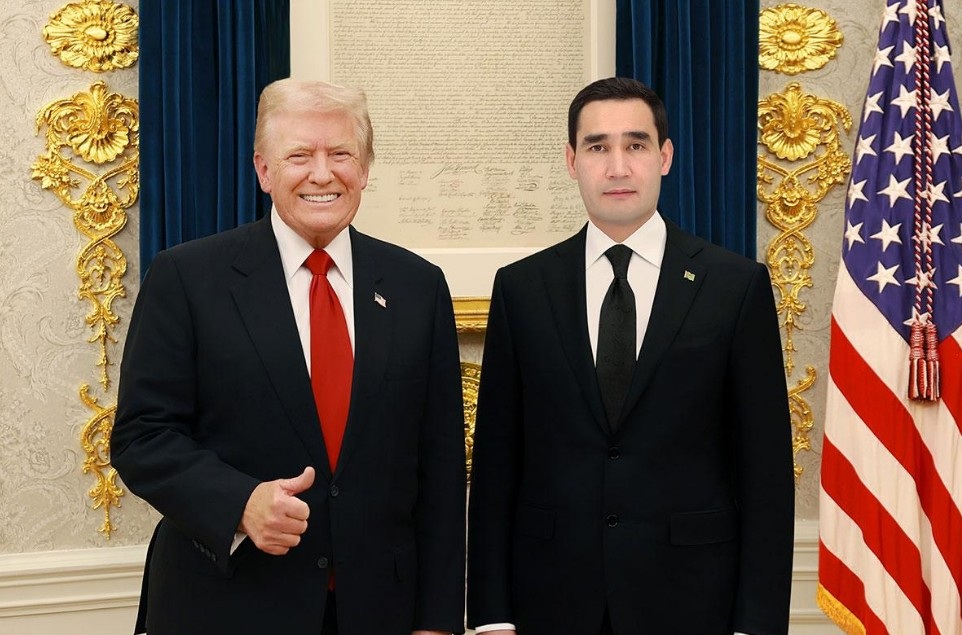
 Donald Trump and Serdar Berdimuhamedov. Photo via arzuw
Washington intends to support the diversification of export routes for Turkmen energy resources and foster transport links between Central Asia and Europe via the Caspian Sea and the South Caucasus. These matters took center stage during the visit to Ashgabat by U.S. Deputy Secretary of State Christopher Landau, who held talks on November 23 with Turkmenistan’s President Serdar Berdimuhamedov and Foreign Minister Rashid Meredov.
Ahead of the American diplomat’s trip, the State Department signaled Washington’s interest in advancing a Trans-Caspian corridor for Turkmen energy exports, linking the initiative to the implementation of the «Trump Route for International Peace and Prosperity» (TRIPP). Following the talks, the Turkmen Foreign Ministry confirmed that both sides discussed alternative energy and transport corridors.
Over the past two decades, China has successfully built an infrastructure network in Turkmenistan that secures its access to some of the world’s largest natural gas reserves. In parallel, Beijing is developing transport corridors across the republic, including links to Iran and Turkey. Now, the Donald Trump administration is urging Ashgabat to pivot toward western routes, in the creation of which the United States aims to play a direct role.
From Moscow to Beijing
Following the collapse of the Soviet Union, Turkmenistan found itself in a precarious position. Despite possessing vast natural gas reserves, the republic had virtually no autonomy in selecting its buyers. The Soviet-built Central Asia–Center pipeline network funneled supplies primarily through Russia, which acted simultaneously as both the purchaser of Turkmen fuel and the transit state.
Ashgabat began seeking alternative markets under the country’s first president, Saparmurat Niyazov. In 1997, the Korpedzhe–Kurt-Kui pipeline came online, connecting Turkmenistan with Iran. However, the most ambitious diversification project materialized in partnership with China.
In April 2006, Ashgabat and Beijing signed an intergovernmental agreement to construct a pipeline and supply Turkmen natural gas to the PRC. Three years later, in December 2009, the pipeline was officially inaugurated. China gained access to Central Asian resources via a route traversing Turkmenistan, Uzbekistan, and Kazakhstan.
The milestone arrived during a period of acute strain in Russian-Turkmen gas relations. In April 2009, an explosion on a major trunkline halted Turkmen deliveries to Russia for several months. In the years that followed, procurement volumes by Russia’s Gazprom plummeted significantly.
China offered Turkmenistan far more than just an additional export market. Chinese companies and financial institutions helped develop export infrastructure, tap gas fields, and build processing plants. In doing so, Beijing secured a foothold along virtually the entire production chain—from extracting raw reserves to delivering them into Chinese territory.
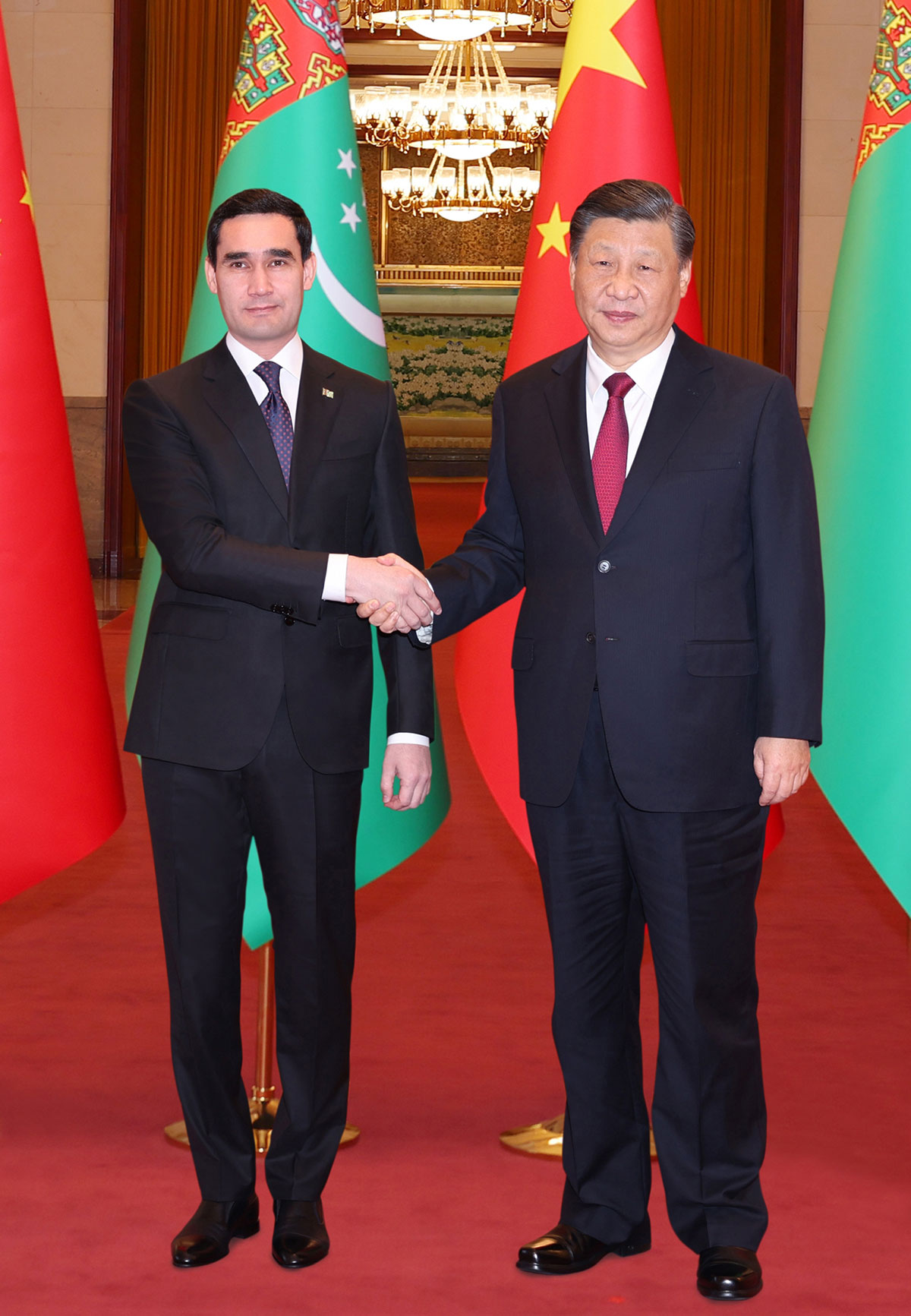 Xi Jinping and Serdar Berdimuhamedov. Photo via DHT
By March 1, 2026, approximately 460 billion cubic meters of gas had been transported through the Turkmenistan–China pipeline. The system currently operates via three lines boasting a combined capacity of 55 billion cubic meters per year, pumping gas to China not only from Turkmenistan, but also from Kazakhstan and Uzbekistan.
According to a study by the World Bank, China accounted for 96% of Turkmenistan’s gas exports in monetary terms in 2022. The PRC’s share in Turkmenistan’s overall exports climbed from 0.3% in 2007 to 58.7% in 2023.
According to Chinese Ambassador to Ashgabat Ji Shumin, Turkmenistan supplied around 30 billion cubic meters of gas to China in 2025. That same year, the country’s total output stood at roughly 76.5 billion cubic meters. The Chinese market thus absorbs nearly 40% of all gas produced nationwide.
This cooperation continues to expand. In April 2026, state concern Turkmengaz and China National Petroleum Corporation (CNPC) signed a contract to launch the fourth phase of development at the Galkynysh field, one of the largest in the world. The project is valued at $5.1 billion, according to Reuters, and entails adding 10 billion cubic meters of annual commercial gas processing capacity.
Concurrently, plans for a fourth pipeline branch to China, slated to pass through Uzbekistan, Tajikistan, and Kyrgyzstan, remain on the table. With a projected capacity of 30 billion cubic meters per year, the link would allow Ashgabat to scale up annual deliveries to China to 65 billion cubic meters upon completion.
Negotiations over the new route, however, have dragged on for over a decade, with Ashgabat and Beijing unable to reach an agreement on final terms. This ongoing impasse has further piqued the Turkmen leadership’s interest in cultivating alternative buyers.
The American Route
Washington was actively eyeing alternative export routes for Turkmen gas long before China’s pipeline infrastructure emerged. Back in the 1990s, American oil and gas firm Unocal helped design a pipeline project from Turkmenistan through Afghanistan to Pakistan—the forerunner of today’s TAPI (Turkmenistan–Afghanistan–Pakistan–India) pipeline.
At the same time, the U.S. administration championed a westward corridor. In April 1998, following talks between U.S. President Bill Clinton and Turkmen counterpart Saparmurat Niyazov, the White House released a joint statement backing the construction of a Trans-Caspian Gas Pipeline. In November 1999, related agreements were hammered out in Istanbul between Turkmenistan, Azerbaijan, Georgia, and Turkey, with U.S. participation.
At the time, Washington aimed to establish Caspian energy export corridors that bypassed both Russia and Iran. While that goal was partially achieved on the oil front through the Baku–Tbilisi–Ceyhan pipeline, the parallel venture for Turkmen gas never left the drawing board.
Nearly three decades later, the United States is revisiting the concept, albeit against a transformed geopolitical backdrop. China has supplanted Russia as the primary customer for Turkmen gas, while the South Caucasus is developing the groundwork for transport corridors established with direct U.S. involvement.
In August 2025, with Donald Trump mediating in Washington, Armenian Prime Minister Nikol Pashinyan and Azerbaijani President Ilham Aliyev signed a joint declaration to unblock regional transit communications. A cornerstone of the pact is a transit corridor linking mainland Azerbaijan to its Nakhchivan Autonomous Republic via southern Armenia.
 Donald Trump, Ilham Aliyev, and Nikol Pashinyan. Photo via alphanews.am
TRIPP, however, was designed from the outset as more than just road and rail infrastructure. A May 26, 2026, Armenia–U.S. framework agreement, published on the Armenian Foreign Ministry website, lists oil and gas pipelines, power transmission lines, and fiber-optic cables among prospective ventures. The U.S. side is set to hold a 74% stake in the joint development enterprise, with Armenia retaining 26%. The initial infrastructure concession runs for 49 years.
Washington is thus positioning itself for an enduring commercial foothold along a vital route linking the Caspian basin to Turkey. Yet for this corridor to thrive, it requires steady freight traffic and, should pipeline infrastructure be realized, energy supplies. Against this backdrop, Turkmenistan assumes outsized importance.
Tellingly, Landau’s visit to Ashgabat marked the second round of high-level U.S.–Turkmen talks in November alone. On November 3, the Turkmen capital hosted political consultations involving Assistant Secretary of State for South and Central Asian Affairs Paul Kapur, which likewise centered on Trans-Caspian connectivity and energy export diversification.
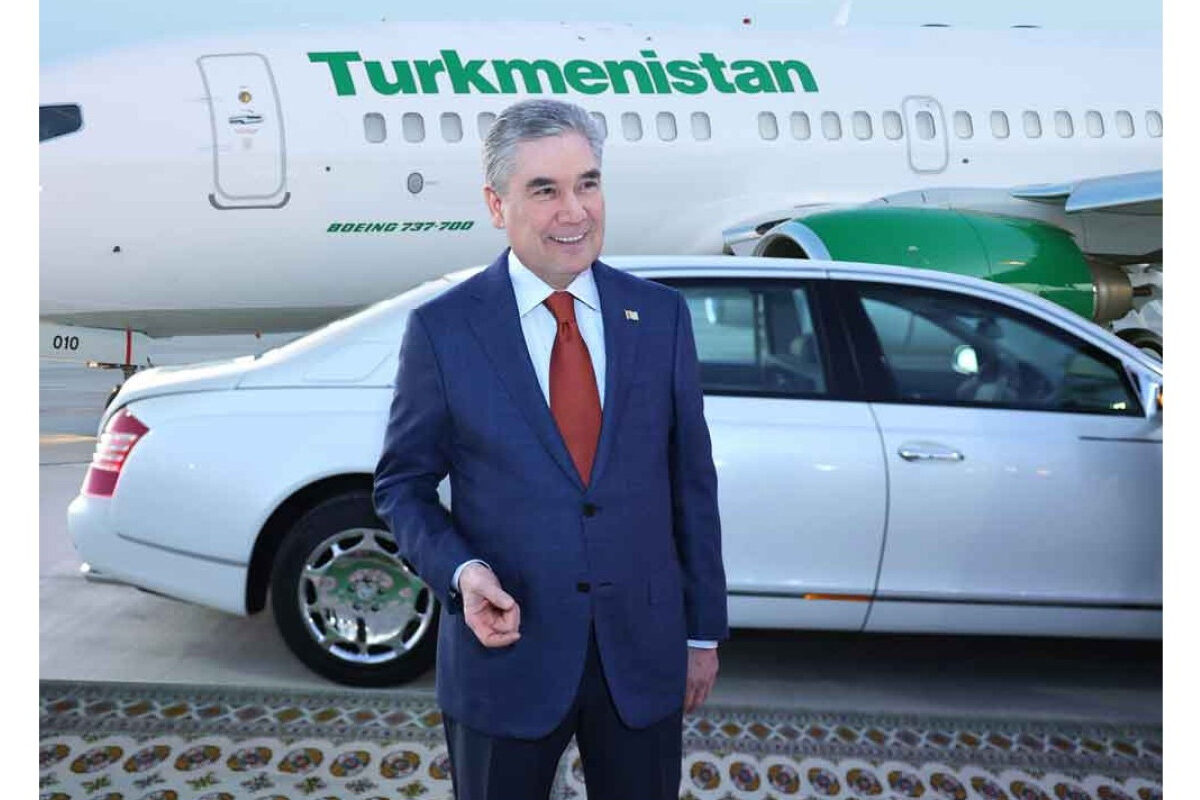 Gurbanguly Berdimuhamedov. Photo via TDH
Earlier, in February 2026, Halk Maslahaty Chairman Gurbanguly Berdimuhamedov traveled to the United States. During the visit, he affirmed Ashgabat’s drive to broaden its gas export horizons, naming diversification as one of the nation’s top priorities.
Yet the contest between Washington and Beijing for sway over Turkmenistan extends well beyond energy. China has systematically integrated the republic into its own network of Eurasian transit corridors.
In June 2025, the inaugural freight train departed Jinhua in China’s Zhejiang province, bound for the port of Turkmenbashi. By August of that year, railway officials from China, Kazakhstan, Uzbekistan, Turkmenistan, Iran, and Turkey gathered in Beijing to hammer out unified freight tariffs along the southern overland route connecting the PRC with Europe.
In May 2026, a new multimodal corridor was launched to ship Chinese goods to Afghanistan through Kazakhstan, Uzbekistan, and Turkmenistan. Cargo travels by rail to Bukhara before being trucked across Turkmen territory to Herat, Afghanistan.
The construction of the China–Kyrgyzstan–Uzbekistan railway is expected to provide further momentum to these links. Connecting it to the existing Central Asian rail network will grant Beijing another conduit to Turkmen ports, Iran, and onward to the Middle East and Europe.
Turkmenistan is effectively emerging as a pivotal crossroads where several rival Eurasian transport routes converge. Some channel freight through Iran, while others run across the Caspian Sea and the South Caucasus. Crucially, Chinese merchandise can flow along both corridors.
This is why the U.S. initiative cannot be viewed merely as an attempt to squeeze out China. Washington is working to build infrastructure in which American capital can directly participate in development and operation, even if Chinese manufacturers supply a substantial share of the freight traffic.
The Pipeline of Contention
There remains, however, a fundamental divergence between the American blueprint and reality on the ground: China already commands operational infrastructure to import Turkmen gas, whereas the western corridor has yet to be built.
The crucial missing link is the Trans-Caspian Gas Pipeline—a subsea link roughly 300 kilometers long intended to bridge the gas transit networks of Turkmenistan and Azerbaijan. Various blueprints have envisioned a capacity of around 30 billion cubic meters annually—roughly matching what Ashgabat currently ships to China.
A long-standing obstacle has been the unsettled legal status of the Caspian Sea. In August 2018, the leaders of the five littoral states—Russia, Kazakhstan, Turkmenistan, Azerbaijan, and Iran—signed a convention in Aktau. Under Article 14 of the document, subsea pipelines may be laid by mutual agreement between the countries through whose seabed sectors the route passes, provided environmental standards are satisfied.
Nevertheless, the delimitation of the Caspian seabed between Turkmenistan and Azerbaijan remains unresolved. Even in February 2026, Gurbanguly Berdimuhamedov, while reaffirming Ashgabat’s interest in building the Trans-Caspian pipeline, pointed out that this dispute must be formally settled.
Furthermore, completing the subsea segment will not automatically deliver Turkmen gas into European homes. It will require expanding the capacity of existing pipelines or building brand-new routes across the South Caucasus and Turkey.
Currently, Caspian gas reaches the European market via the Southern Gas Corridor, which comprises the South Caucasus Pipeline, the Trans-Anatolian Pipeline (TANAP), and the Trans-Adriatic Pipeline (TAP). This network was built primarily to pump Azerbaijani fuel. Tying Turkmenistan into the system on a scale comparable to its Chinese exports would demand massive capital investment.
In this context, TRIPP offers another potential avenue for laying energy corridors across the South Caucasus. However, no decisions regarding a specific gas pipeline through Armenian territory have been made public.
Turkey, which aspires to become a major international gas trading hub, could play a decisive role in realizing the western route. Turkish Minister of Energy and Natural Resources Alparslan Bayraktar previously voiced intentions to increase imports of Turkmen gas to 15 billion cubic meters per year.
In March 2025, Ankara began receiving Turkmen gas through swap arrangements with Iran. Under this framework, Turkmenistan delivers fuel to northern Iran, which then releases equivalent volumes to Turkey. Ankara, however, views a direct Trans-Caspian link as indispensable for any dramatic increase in import volumes.
Equally critical is the question of end buyers. In January 2026, the European Union approved a phased embargo on Russian natural gas, with a ban on supplies under existing long-term pipeline contracts set to take effect in the fall of 2027. Turkmenistan could theoretically capture part of this vacated market share.
At the same time, European gas consumption is trending downward, while liquefied natural gas (LNG) imports are climbing. Notably, the United States has emerged as one of the primary beneficiaries of this structural shift in Europe’s energy market. According to the Council of the EU, American gas shipments to the bloc surged from 18.9 billion cubic meters in 2021 to 75.6 billion in 2025.
This creates a conspicuous paradox: by facilitating Turkmenistan’s entry into the European market, Washington risks fostering a direct competitor for its own LNG exporters. This suggests that the U.S. administration’s interest in Turkmen gas extends beyond mere energy trade. It is fundamentally tied to shaping Eurasia’s transit architecture, securing roles for American firms in regional infrastructure, and expanding the U.S. economic footprint across Central Asia and the South Caucasus.
Stringent EU environmental standards present another potential hurdle. Turkmenistan ranks among the nations facing severe challenges with methane leaks during hydrocarbon extraction and transit. As the U.S. Energy Information Administration observes, without substantial modernization of its oil and gas sector, the republic risks running afoul of European regulatory standards for imported fuel.
Ashgabat, meanwhile, is not pinning its hopes entirely on the West. Work continues on the TAPI pipeline, designed for an annual capacity of 33 billion cubic meters. Turkmen officials plan to complete the stretch to Herat, Afghanistan, by the end of 2026. However, the project’s future hinges on Afghan-Pakistani relations, project financing, and robust security guarantees.
Cultivating multiple major buyers would strengthen Turkmenistan’s hand in negotiations with Beijing—especially as competition within the Chinese gas market heats up alongside surging Russian flows via the Power of Siberia pipeline.
Yet it would be a mistake to view Ashgabat purely as a captive of Chinese capital. In June 2021, Turkmen authorities announced the full repayment of loans borrowed from the China Development Bank to construct the pipeline network and develop the Galkynysh field. Today, the republic’s primary vulnerability is not its debt to Beijing, but the sheer lack of alternative markets of comparable scale.
So far, the United States has offered Turkmenistan nothing equivalent to the working Chinese model. Landau’s visit yielded no announcements regarding funding for the Trans-Caspian pipeline, long-term procurement contracts for Turkmen gas, or the entry of American majors into new development phases at Galkynysh.
Still, the interests of Washington and Ashgabat currently align on several fronts. The U.S. administration is keen to build new Eurasian corridors with American involvement, while Turkmenistan urgently needs to diversify its exports. Over the past two decades, China has successfully turned Turkmen gas reserves into a pillar of its own energy security; now, Washington must demonstrate that it can match its diplomatic ambitions with tangible investment.
-
 10 November10.11China Behind Barbed WireWhy Beijing Trades With the Taliban Through Central Asia but Keeps Its Own Border Closed
-
 09 November09.11A Lake of Wine and a Valley of GrapesAn old Chinese legend and a story from the Fergana Valley offer two ways into the history of drinking in China.
-
 04 November04.11Gas Visible from SpaceTurkmenistan Confronts Its Massive Methane Problem
-
 20 October20.10After the War, a FenceHow the Kyrgyz-Tajik Border Is Being Redrawn on the Ground
-
 20 October20.10Uzbekistan Sets Ambitious Goal to Train One Million Youth Annually in Robotics and TechUzbekistan aims to train 1M youth annually in robotics and game development, targeting 500,000 new tech jobs. Discover its massive digital education plan.
-
 14 October14.10Digital DependenceYandex Data Center Attacks Expose Kazakhstan's Digital Vulnerability
-
Iran Courts the CIS and the Eurasian Economic Union
-
111 groups urge the World Bank to freeze funding for high-mountain dams after Nepal's deadly flood, naming Tajikistan's Rogun among projects to drop
-

Uzbekistan is expanding a Chinese cotton-growing method to a third of its cotton fields
-
Critical minerals, artificial intelligence — what else was discussed at the “Central Asia–Korea” meeting