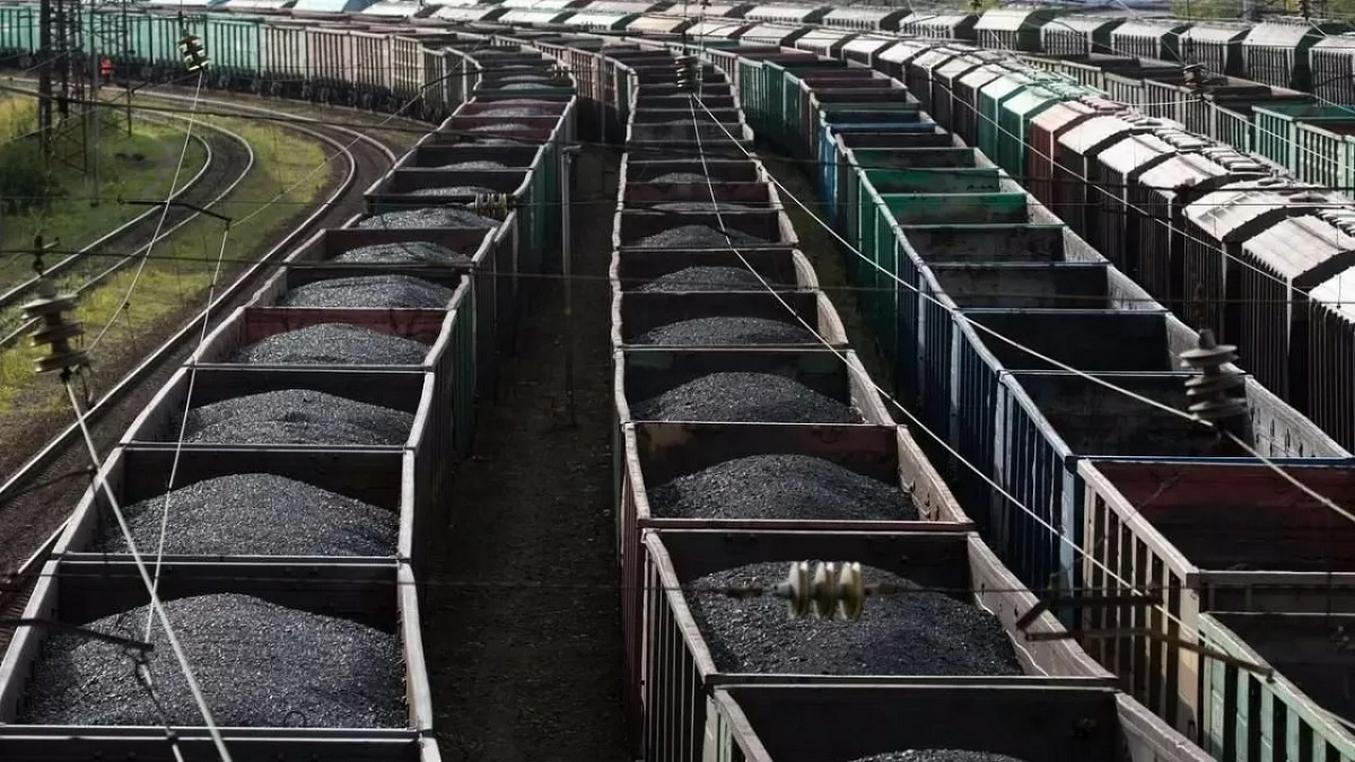
Kazakhstan is exploring alternative export routes after Russia halted approvals for transporting and transshipping Kazakh coal through its Baltic ports, the Central Asian nation’s Ministry of Transport confirmed in response to an inquiry from Ulysmedia.kz.
Russian Railways (RZD) has been curbing shipments of Kazakh coal bound for Russian seaports since late summer. Citing severe rail congestion, RZD has approved only a fraction of requests from Kazakh producers, preventing miners from exporting their scheduled volumes.
“To ensure the uninterrupted operation of domestic coal mining companies, this matter is being addressed within the Intergovernmental Commission for Cooperation between the Republic of Kazakhstan and the Russian Federation. A resolution at the level of the commission’s co-chairs is currently pending,” the ministry stated.
In November, transport ministries and railway authorities from both countries are scheduled to hold talks to review shipment volumes for 2026 and coordinate operational plans for 2027.
With the RZD issue still unresolved, Kazakhstan is mapping out alternative routes for its coal exports.
“Options under consideration include transit via the Republic of Belarus (Orsha station), along the Trans-Caspian International Transport Route toward the Port of Poti, via Dina Nurpeisova station toward Poti, as well as shipments bound for the Latvian ports of Riga and Ventspils,” the ministry noted.
All of these alternatives remain under review.
Earlier, Russia’s Vedomosti, citing a market report by energy price reporting agency Argus, reported that RZD had rejected transit requests for Kazakh coal bound for Baltic terminals for both October and November.
According to the data, roughly one million metric tons of Kazakh coal moved across Russian territory in August, falling to 500,000 tons in September, and plunging to just 30,000 tons in October. Monthly shipments collapsed by a factor of 33 in just two months.
In October, deliveries continued exclusively via rail links toward Belarus and Poland, while sea-bound loadings via Russian Baltic terminals ground to a virtual halt.
Argus attributed the bottleneck to severe congestion across Russia’s rail network.
Disruptions to maritime traffic in the Black and Azov seas diverted a portion of Russian export freight to the northwest. This inundated rail approaches to Baltic terminals, forcing Russian and Kazakh shippers to compete for scarce rail capacity.
Russian transit remains critical for landlocked Kazakhstan, which relies heavily on Russian railways and marine terminals to move the bulk of its coal exports.
Key buyers of Kazakh coal include Poland, the Netherlands, and Turkey. Russian infrastructure is also utilized to supply markets in China, Japan, and Malaysia.
In 2025, Kazakh coal exports transiting Russia surged by 27% to a record 11.7 million tons. That momentum continued through the first half of 2026, with volumes rising 20% year-on-year to 7.8 million tons.
Between January and July, the Port of Ust-Luga handled over 4.7 million tons of Kazakh coal—a 1.8-fold jump compared to the same period last year. Another 2.6 million tons moved through OTEKO’s terminal in Taman. However, loadings there were halted in early August amid shipping disruptions across the Black and Azov seas.
As a result, Kazakh exporters faced simultaneous bottlenecks along both critical outbound corridors—the southern and the northwestern.
Russian Far East ports could theoretically offer an alternative to European destinations, but analysts warn that pivoting flows quickly will be difficult.
Alexander Kotov, a partner at NEFT Research, pointed out that Kazakh coal has historically targeted European markets and Russia. Maksim Shaposhnikov, an adviser to the management of the Industrial Code fund, noted that even if buyers are secured in Asia, rerouting through Far Eastern ports could prove unprofitable due to steep rail tariffs. Furthermore, eastern infrastructure is already operating near capacity handling domestic Russian export flows.
Industry observers argue that resolving the Kazakh transit bottleneck depends largely on normalizing operations at Azov-Black Sea ports. Should Russian exporters shift traffic back to southern routes, pressure on rail corridors leading to the Baltic could ease.
Analysts estimate that conditions are unlikely to stabilize before the first quarter of 2027, though a partial reprieve could emerge by December or January once seasonal grain export peaks subside.